
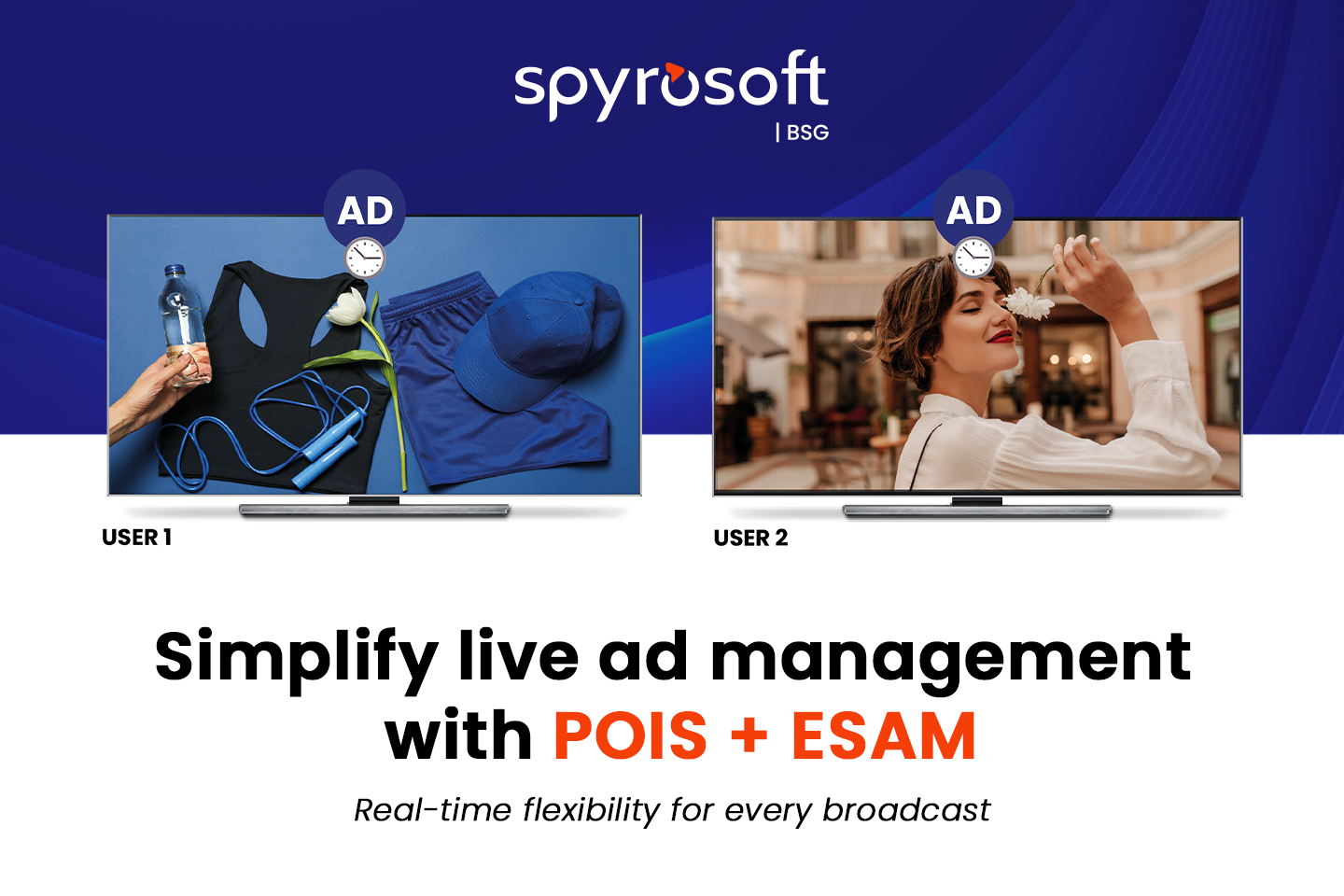
When live content is unpredictable, rigid ad workflows become a liability. A football game goes into overtime, a tennis rally lasts longer than expected, or breaking news interrupts scheduled programming – and yet, the ad break stays fixed.
For broadcasters, every missed second can mean lost revenue, compliance issues, and frustrated advertisers demanding more control. According to industry estimates, inefficient ad delivery and mistimed spots cost broadcasters millions every year. And while the rise of streaming has introduced dynamic ad insertion (DAI) tools, live broadcasts remain the toughest environment to manage.
Why? Because most ad-tech systems still operate too far downstream – closer to the player than to the source.
Why traditional workflows fall short
In a typical broadcast setup, advertising opportunities are defined by SCTE-35 markers – digital cues that indicate when a break starts or ends. These signals travel downstream to trigger ad insertion via servers or playout systems.
That approach works well for scheduled content but struggles with live broadcasts, where timing is constantly changing. A few seconds of overtime can throw off the schedule and cause misfires. The result: missed opportunities, repeated spots, and manual corrections.
Common pain points include:
- Lost ad inventory when breaks don’t align with the live feed.
- Increased operational load due to manual marker adjustments.
- Limited regional flexibility, especially across multiple feeds.
- Compliance risks when timing errors occur during regulated broadcasts.
Even sophisticated downstream systems can’t solve these problems entirely because the real control point sits too far from where the live signal originates.
Moving ad control to the source
To solve the problem, broadcasters are rethinking where control happens. Instead of relying solely on downstream systems, ad management can now take place at the head end – the point where content originates and is prepared for distribution.
This shift allows broadcasters to manage ads at the signal level, reacting to live events in real time. Rather than waiting for downstream systems to catch up, ad control happens at the source – instantly, automatically, and accurately.
This approach depends on two key technologies:
- SCTE-35 which defines opportunities for ad placement within the video stream.
- ESAM (Event Signalling and Management), which manages those opportunities dynamically and ensures correct ad execution.
Together, they enable real-time flexibility, improved compliance and smoother viewing experiences across multiple platforms.
How POIS and ESAM make it possible
At Spyrosoft BSG, we’ve built two complementary tools that make head-end ad control simple, scalable and effective: POIS and ESAM.
POIS – Placement Opportunity Information Service
POIS defines and manages all potential ad placement points within a broadcast. It tells the system where ad opportunities exist and provides structured data about each one –duration, timing, and conditions. This ensures that all opportunities are clearly defined and available for use at any moment.
ESAM – Real-Time Event Signaling and Management
ESAM is the system that executes those opportunities in real time. It determines how and when each placement is activated – inserting, replacing, or removing ads directly at the signal level. ESAM also ensures compliance with SCTE-35 rules automatically, without the need for manual marker edits.
When used together, POIS and ESAM provide broadcasters with:
- Full control at the signal level – insert or change ads in seconds.
- Accurate regional targeting from a single master feed.
- Automatic marker compliance, removing manual adjustments.
- New monetisation options, without heavy infrastructure changes.
This combination gives broadcasters both agility and confidence – the ability to react instantly while maintaining operational stability.
From metadata to monetisation
POIS and ESAM together bridge the gap between broadcast, OTT, and programmatic TV. By enriching SCTE-35 markers with contextual metadata (such as IAB categories and segment IDs), broadcasters can feed downstream SSPs and DSPs with structured, standardised data, enabling advertisers to target audiences with precision and value ad inventory more effectively.
This approach supports a wide range of use cases:
- Context-driven ad replacement – trigger specific ad campaigns (e.g., sports betting, food delivery, automotive) based on live content context.
- Regional targeting and blackout management – replace or mute content in restricted territories while monetising alternative feeds.
- Regulatory compliance – ensure ad replacement when certain categories (e.g., alcohol, gambling) are restricted.
- Operator-level differentiation – deliver customized ad inventories to different operators without affecting the core broadcast.
- Event-driven flexibility – dynamically adjust ad breaks during live sports or concerts to maximise relevance and revenue.
In short, it’s a business enabler: connecting ad tech with broadcast operations to unlock new revenue streams.
Real-world example: ITV’s path to regional ad precision
Context
ITV, one of the UK’s largest commercial broadcasters, delivers a mix of national shows, regional news, and live sports across multiple regions. As regional and addressable advertising became increasingly valuable, the broadcaster’s EPG-based ad workflows proved too rigid. Advertisers sought to target specific areas – London vs. Manchester, for example – but uniform ad breaks across all regions limited flexibility and revenue potential.
The challenge
ITV’s traditional ad model relied on fixed EPG schedules and downstream SCTE-35 signaling. This approach led to:
- Lost ad opportunities when live programs ran over schedule.
- Manual configuration and maintenance for each region.
- Limited ability to execute dynamic, region-specific campaigns.
- Compliance challenges with OFCOM timing requirements.
The solution
Spyrosoft BSG introduced POIS at ITV’s head end, integrating it directly with the broadcaster’s EPG and automation systems.
POIS continuously monitors live playout and adjusts SCTE-35 markers in real time, ensuring each region receives the same program feed but with custom ad triggers.
If a live event extends, POIS automatically synchronises new break timings with both EPG data and regional ad servers — enabling regionalised, context-aware advertising without duplicating feeds.
Results and benefits
- For ITV: Increased flexibility, reduced manual operations, and new regional ad inventory.
- For advertisers: Precise geo-targeting and better ROI through locally relevant spots.
- For viewers: Seamless, synchronised ad breaks aligned with their region and context.
Business impact
By implementing POIS with EPG integration, ITV gained dynamic control over regional ad delivery. The broadcaster can now serve tailored campaigns per region, maintain compliance automatically and enhance consistency across both linear and digital platforms, all from a single, unified feed.
A practical path to modern ad control
Implementing new ad management doesn’t have to mean rebuilding the entire broadcast chain. Spyrosoft BSG’s process is fast, flexible and proven in live environments:
- Consultation – Assess your existing systems and identify challenges.
- Pilot rollout – Test POIS + ESAM on selected channels or live events.
- Full deployment – Integrate with encoders, ad servers and monitoring tools.
- Continuous support – 24/7 assistance, system updates and optimisation.
This approach allows broadcasters to modernise at their own pace – minimising risk while maximising performance.
Simple, scalable licensing
POIS is licensed per active channel – offering predictable operational costs.
Each license includes:
- 24/7/365 technical maintenance and monitoring.
- Dedicated DevOps and backend engineers.
- Ongoing performance optimisation.
- Access to a Solution Architect for future integrations.
This model lets partners scale quickly without heavy upfront investment.
Why now is the time to act
The global digital video advertising market is projected to reach $659 billion by 2030 with much of that growth driven by live sports and event-based programming.
Advertisers expect flexibility and precision – the ability to target audiences regionally, respond to real-time moments and maintain consistency across devices. Broadcasters that can deliver this control gain a significant competitive advantage.
With POIS and ESAM, that level of control is not only possible but practical. The systems empower broadcasters to act instantly, automate complex processes and build new revenue models around the moments that matter most.
Get in touch with our media tech team to discuss how head-end ad control could work for your operations!
If you find this article valuable, you can share it on social media →
Read more about the VOD & OTT Industry!
Media technology integration: turning stacks into systems
Learn how POIS and ESAM move ad control to the source, giving broadcasters real-time flexibility and regional targeting.
What is Amazon Vega OS and why it matters for Fire TV users
Amazon unveils Vega OS, a new Linux-based system replacing Android on Fire TV. Faster, lighter, and built for independence from Google’s ecosystem.
Why services, not more products, solve media & entertainment challenges
The challenge in media and entertainment isn’t more tech, but making existing tools work together to deliver real results.
Are you looking for a partner to build a Video Solution?
Leave your email and a short description about your project. We would gladly discuss different cooperation possibilities!