
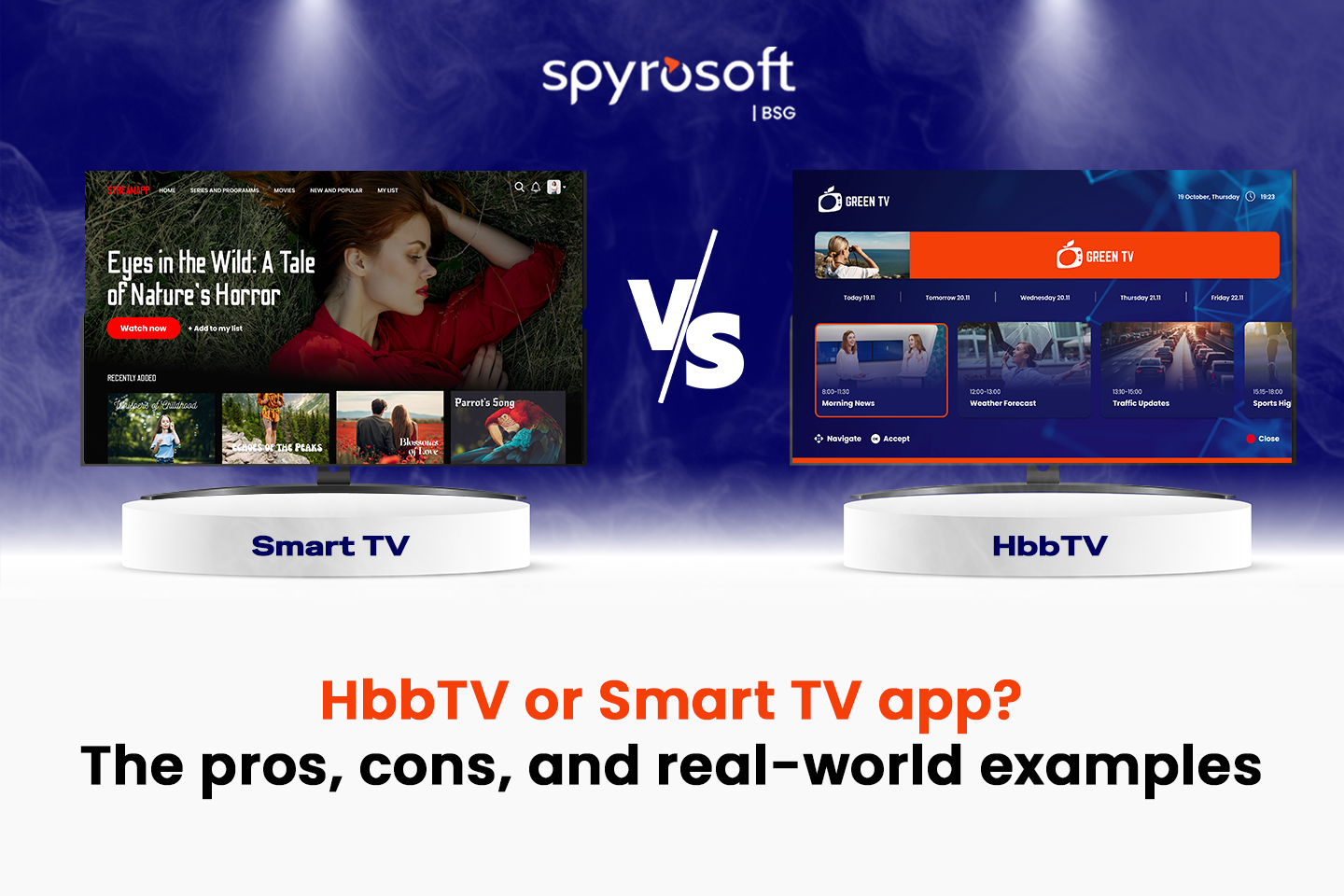
As Smart TVs still dominate living rooms across Europe, media companies face a growing dilemma: should they invest in an HbbTV experience or develop a native Smart TV app?
Both options offer a way to reach audiences directly on their TVs – but they serve different purposes, have different capabilities and suit different business objectives. HbbTV (Hybrid Broadcast Broadband TV) is deeply integrated into the broadcast signal and widely used by public and regional broadcasters in Europe. Meanwhile, Smart TV applications offer greater flexibility, richer interfaces and wider monetisation potential – especially for VOD-based services.
If you are planning your strategy for 2025, this article will guide you through the pros and cons of each path, help you compare key features and show real-world examples of how others are doing it. The aim? To help you choose an approach that fits your content, audience and long-term strategy.
What is HbbTV?
HbbTV (Hybrid Broadcast Broadband TV) is a standard used mainly in Europe that combines traditional broadcast television with internet-based features. It’s designed to bring interactive services like catch-up TV, video-on-demand, program guides, or live voting directly to the viewer’s screen, without requiring them to install a separate app.
Instead, HbbTV works as an overlay on top of the live TV signal. When a viewer sees a prompt (usually the familiar red button icon) and presses their remote, they gain access to additional content delivered via broadband. It all happens within the TV’s built-in browser, using a simplified interface that works across supported devices.
HbbTV has become a widely adopted standard across Europe, especially among public and regional broadcasters who want to expand the reach of their linear programming without the cost or complexity of building custom apps. Countries like Germany, France, Spain, the UK, and the Nordics have seen strong uptake and most new Smart TVs sold in Europe today come with HbbTV support out of the box.
In 2025, HbbTV is more than just a red button. The latest version, HbbTV 2.0.3, brings support for adaptive streaming, second-screen integration, targeted advertising and improved video performance.
However, it’s important to note that HbbTV has its limits. It’s not as flexible as a native Smart TV app in terms of user experience, branding, or monetisation. It’s ideal for enhancing broadcast, but not always the best choice for on-demand-first platforms or those looking to create a fully customised experience.
What is a Smart TV app?
A Smart TV app is a dedicated application developed for Smart TV platforms like Samsung Tizen, LG webOS, Android TV / Google TV, Apple tvOS, or Roku. Unlike HbbTV, which relies on the broadcast signal and web-based overlays, a Smart TV app runs natively on the device and is launched directly from the TV’s main menu just like Netflix, Disney+, or YouTube.
These apps are widely used by streaming services, broadcasters, and content providers who want to deliver content with a fully branded, highly customisable user experience. Smart TV apps offer far greater flexibility than HbbTV, allowing for advanced features such as:
- Personalised recommendations
- Multi-language support
- Adaptive streaming
- User profiles and parental controls
- In-app purchases and advertising integration
- Rich analytics and viewer insights
Because they’re platform-specific, Smart TV apps can leverage native APIs and design guidelines to create smooth, responsive interfaces optimised for each device. This makes them a great fit for VOD-first platforms, or any business aiming to scale its reach across multiple countries and device ecosystems.
Another key advantage is monetisation. Smart TV apps support SVOD, AVOD, TVOD, or hybrid revenue models and provide more opportunities for targeted advertising and upselling – something that’s limited in HbbTV environments.
In short, if you’re looking for a way to offer a premium, interactive, and revenue-generating experience on the big screen, a Smart TV app is often the smarter long-term investment, especially outside of strictly broadcast-driven contexts.
HbbTV vs Smart TV app: comparison
Both HbbTV and Smart TV apps offer a way to reach viewers directly on their televisions but they serve different needs, rely on different infrastructures, and offer different possibilities when it comes to user experience, flexibility and monetisation.
To help you decide which path fits your business, here’s a breakdown of the key differences:
| Feature | HbbTV | Smart TV App |
| Platform scope | Primarily Europe | Global reach (Tizen, webOS, Android TV, Roku, etc.) |
| Deployment method | Via broadcast signal + broadband overlay | Via Smart TV app store or sideload |
| User experience (UX) | Basic interface, limited by browser-based rendering | Fully custom UI/UX, smooth navigation, animations |
| Monetisation options | Limited (basic ads, no in-app billing) | Full monetisation support (SVOD, AVOD, TVOD, hybrid) |
| Viewer interaction | Red button, simple overlays | Advanced interactivity, personalisation, recommendations |
| Content discovery | Integrated with linear broadcast (EPG, overlays) | Independent discovery paths, full content control |
| Analytics and tracking | Limited, often anonymised | Deep insights, user-level analytics |
| Integration complexity | Easy for broadcasters; tied to existing broadcast infrastructure | Requires app development, certification, and ongoing updates |
| Branding flexibility | Minimal | High – full branding and UX control |
| Ideal use case | Enhancing linear TV with interactive features | VOD-first services, global streaming apps, branded experiences |
Both approaches have value, but they solve different problems.
If your goal is to complement a linear broadcast, engage domestic audiences and provide simple interaction, HbbTV may be enough. But if you’re focused on scaling your streaming service, controlling the experience and maximising monetisation, then Smart TV apps offer far more possibilities.
When to choose HbbTV
While Smart TV apps offer more freedom and monetisation options, there are still strong reasons to choose HbbTV, especially if you’re working in a broadcast environment, which is typical for many European markets.
You should consider HbbTV if:
- Your primary distribution is still broadcast TV
If your content is delivered via DVB-T, satellite, or cable, HbbTV allows you to extend linear transmission without requiring viewers to download anything new. It’s a natural way to enhance the traditional TV experience.
- You need to reach audiences with minimal barriers
HbbTV services are often available out of the box on millions of Smart TVs across Europe. Viewers don’t need to search for or install an app – they simply press a button on their remote control. This lowers the barrier to entry and provides a wider reach to less tech-savvy audiences.
- You want to enhance programmes with interactive features
HbbTV is ideal for adding real-time voting, extra content, multi-camera views, programme guides, or catch-up TV linked directly to live shows – all while viewers stay inside the familiar broadcast environment.
- Budget and time-to-market are critical
Launching an HbbTV service is often quicker and more cost-effective than building a full Smart TV app ecosystem. For many broadcasters, it’s a practical way to test interactive services without committing to major platform investments.
When to choose a Smart TV app
If you’re building a service that is streaming-first or aiming for full control over your content and user experience, a Smart TV app is usually the better choice.
You should consider developing a Smart TV app if:
- You want full control over branding and UX
Smart TV apps allow you to create custom-designed interfaces that match your brand identity. You’re not limited by browser performance or basic layouts. Your app can look, feel and behave exactly the way you want.
- Monetisation is a priority
Whether you’re offering subscriptions (SVOD), ads (AVOD), pay-per-view (TVOD), or a mix of models, Smart TV apps give you flexibility to build your own revenue streams. You also have more options to integrate advanced ad-tech solutions, in-app purchases, and personalised offers.
- You aim for global reach
If your target market goes beyond Europe, or you want to scale across different device ecosystems (Samsung, LG, Android TV, Roku, Apple TV), Smart TV apps are the only real option. HbbTV support is mainly limited to Europe, while Smart TV platforms are available worldwide.
- You plan long-term evolution
With an app, you control the roadmap. You can roll out new features, updates, and improvements based on viewer feedback and changing market needs, without depending on broadcast standards or signal coverage.
Can you combine both? (hybrid strategy)
Choosing between HbbTV and Smart TV apps doesn’t always have to be an either-or decision. In fact, more and more broadcasters and content providers are adopting a hybrid strategy combining the strengths of both approaches to maximise reach and engagement.
HbbTV as the first touchpoint
HbbTV offers a direct and easy entry point for viewers who are already watching linear TV. By using a simple overlay or red button prompt, you can introduce additional services like catch-up TV or live event extras without requiring users to leave the broadcast flow.
Smart TV apps for deeper engagement
While HbbTV is great for discovery and interaction during live programming, Smart TV apps are essential for delivering a full, immersive experience. Through native apps, you can offer advanced features like personal profiles, content recommendations, subscriptions, and premium video libraries – all optimised for an on-demand viewing mindset. For content owners who want more control over monetisation, branding and data, apps are simply a must-have.
Segmenting your audience smartly
A hybrid strategy lets you adapt to different user behaviours.
- Linear-first audiences stay connected via HbbTV services.
- Streaming-first viewers find richer, tailored experiences through apps.
By combining both, you avoid forcing users into a model that doesn’t fit their habits.
Real-world examples
ARD and ZDF (Germany)
Germany’s public broadcasters, ARD and ZDF, have long used HbbTV services to enhance their live broadcasts with additional features such as catch-up TV, extended news coverage, and interactive voting during live shows. At the same time, they offer fully featured Smart TV apps – available across Tizen, webOS, Android TV, and HbbTV App Launchers that deliver a richer on-demand experience, user profiles, and access to exclusive digital content.
BBC iPlayer (United Kingdom)
The BBC initially introduced HbbTV-like services to complement its linear programmes but focused on the BBC iPlayer app on Smart TV platforms.
Today, iPlayer offers a highly personalised and immersive experience, including live broadcasts, boxes, recommendations, and viewing resume features – designed for both casual viewers and viewing audiences.
Conclusion
Choosing between HbbTV and Smart TV applications is not just a question of technology – it’s about understanding your audience, your business goals, and where you want to be in the next few years.
HbbTV remains a powerful tool for broadcasters who want to improve their linear TV services, offer simple interactivity and remain compliant with regional standards – especially across Europe.
Meanwhile, Smart TV apps provide the flexibility, personalisation, and monetisation options needed to build direct relationships with viewers and scale digital platforms worldwide.
For many content providers, the smartest move is not to choose one side, but to combine both. If you are planning your next move into hybrid TV, this is the right time to think carefully about how HbbTV and Smart TV applications can work with your brand.
Let’s talk about how to make the most of both worlds. Get in touch with our team to explore the best strategy for your content, audience and growth goals!
If you find this article valuable, you can share it on social media →
Read more about the VOD & OTT Industry!
Media technology integration: turning stacks into systems
Learn how POIS and ESAM move ad control to the source, giving broadcasters real-time flexibility and regional targeting.
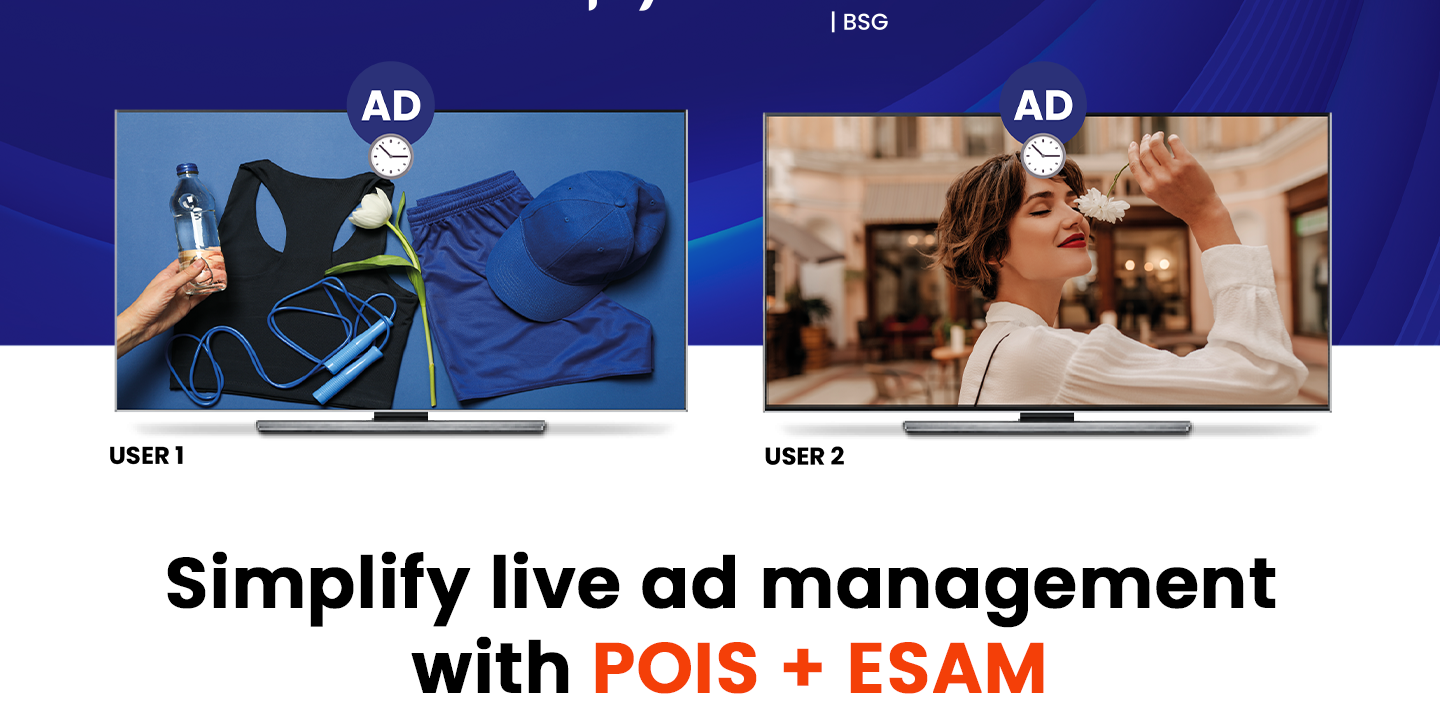
How POIS and ESAM power live ad control
Learn how POIS and ESAM move ad control to the source, giving broadcasters real-time flexibility and regional targeting.
What is Amazon Vega OS and why it matters for Fire TV users
Amazon unveils Vega OS, a new Linux-based system replacing Android on Fire TV. Faster, lighter, and built for independence from Google’s ecosystem.
Are you looking for a partner to build a Video Solution?
Leave your email and a short description about your project. We would gladly discuss different cooperation possibilities!